
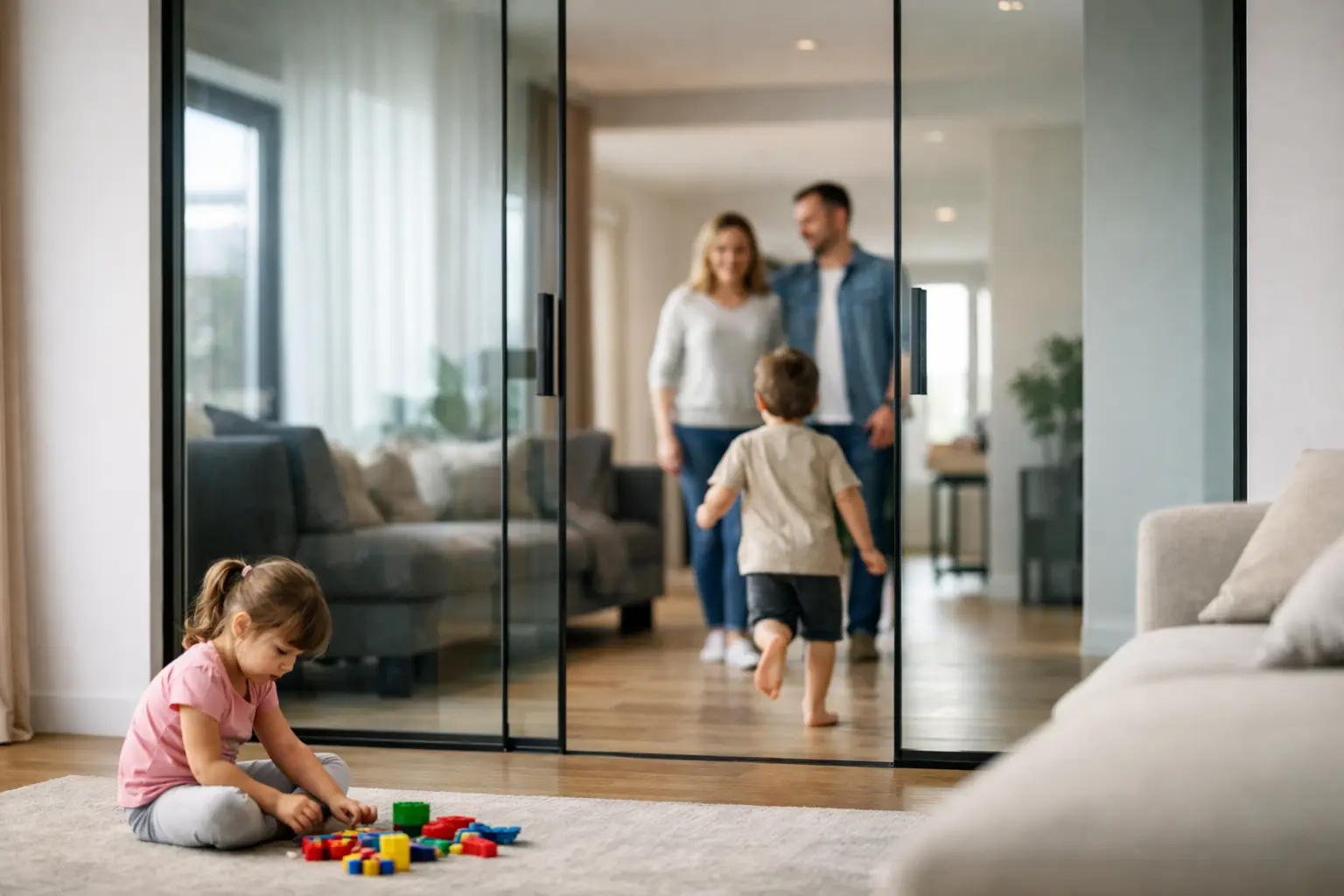
Are Internal Glass Doors Safe in Family Homes?
A well-designed internal glass door should feel like a refined architectural feature, not a compromise on family safety. So, are internal glass doors safe? Yes, provided they are specified with the right safety glass, a properly engineered frame and hardware suited to the way the space will be used.
For homeowners planning an extension, renovation or self-build, internal glazing can transform dark corridors, separate living zones without closing them off, and create a stronger connection between rooms. The key is treating it as a technical product as well as a design choice. Glass type, panel size, door operation and installation quality all matter.
Are internal glass doors safe by design?
Modern internal glass doors are far removed from the fragile single panes many people picture. Doors and adjacent glazed panels in areas where people could reasonably fall against them are generally specified using safety glass. In a UK project, this should be considered alongside the relevant Building Regulations guidance, particularly Part K, which addresses protection from impact.
The right specification depends on where the door sits and how the room is used. A glazed door between a quiet study and a hallway faces different demands from a full-height partition beside a kitchen, playroom or frequently used staircase. A specialist supplier will assess the opening, glazing layout and intended use before recommending the system.
Safety is not only about preventing breakage. It is also about ensuring that a door operates predictably, stays securely within its frame, is easy to see and has hardware that can withstand regular use. Premium internal aluminium door systems bring these details together in a slim, stable frame that supports the glass accurately over time.
The glass that makes the difference
Toughened glass for everyday impact resistance
Toughened glass is heat-treated to make it significantly stronger than ordinary annealed glass. It is a common choice for internal doors because it handles the knocks and pressure of daily life well. If it does break under exceptional force, it is designed to fragment into many comparatively small, blunt pieces rather than large dangerous shards.
This characteristic makes toughened glass well suited to internal hinged doors, sliding doors and glazed partitions. It also delivers the crisp, clear appearance that makes internal glazing so effective in contemporary homes, especially when paired with narrow aluminium sightlines.
However, toughened glass is not indestructible. A sharp impact on an exposed edge, damage caused during transport or incorrect installation can affect performance. That is why accurate measurement, careful handling and correctly designed glazing channels are just as important as the glass itself.
Laminated glass where retained protection is needed
Laminated glass uses two or more sheets of glass bonded together with an interlayer. When broken, the interlayer helps hold the fragments in place. This can be preferable where retaining the pane after impact is a priority, such as certain fixed screens, larger glazed areas or locations close to changes in level.
It can also offer useful acoustic benefits, depending on the glass build-up. For a home office, music room or partition between a kitchen-diner and lounge, this can make a meaningful difference to comfort without losing daylight.
There is no single answer that makes laminated glass automatically better than toughened glass. Both are safety-glass solutions, but they behave differently. The best choice should follow the position of the door, the panel dimensions, required performance and the applicable regulations.
Safe internal glazing starts with the frame
Glass may be the visual focus, but the frame carries much of the responsibility for safe, reliable operation. Aluminium is particularly well suited to internal door systems because it is strong, dimensionally stable and capable of achieving fine sightlines without sacrificing support.
A quality frame keeps the panel aligned, protects its edges and provides a secure fixing point for hinges, rollers, handles and locks. It is especially valuable on tall or wide doors, where a less rigid frame may be more likely to move, bind or fall out of alignment over time.
For hinged internal doors, ask how the hinges are rated for the weight and size of the glazed leaf. For sliding systems, check that the track, soft-close mechanism and anti-lift measures are designed for the panel rather than added as an afterthought. A door should feel controlled in use - not heavy, loose or prone to slamming.
At Cor-Line Systems, internal aluminium doors are considered as complete systems, with the frame, glass and hardware selected to work together. That joined-up approach protects the clean visual result clients want while giving the door the dependable feel expected in a high-use home.
Visibility is a practical safety feature
A beautifully clear glass door can be easy to miss, particularly in bright rooms or when viewed end-on. This is a genuine consideration in homes with children, older relatives, pets or busy family routines.
Manifestation makes glazing more visible. It may be a discreet band, a linear design, etched detail or another marking applied at an appropriate height. The aim is to make the glazed surface apparent without undermining the light, openness and architectural simplicity that led you to choose glass in the first place.
For some schemes, reeded, fluted or lightly obscured glass is an elegant alternative. It improves visual definition and privacy while still allowing daylight to travel through the home. Black aluminium frames combined with fluted glass, for example, can create a refined heritage-inspired look for a pantry, dressing room or en-suite entrance.
Where extra care is worthwhile
Internal glass doors are suitable for most homes, but certain locations deserve closer attention at specification stage. Large panels next to stair landings, doors opening onto narrow corridors, and screens near active children’s spaces all call for careful consideration of glass type, markings and hardware.
Bathrooms and en-suites introduce privacy and moisture into the decision. Obscured or textured safety glass is often the better choice, while hardware should be selected for the environment and maintained properly. In kitchens, a door that separates cooking odours and noise from living space may benefit from a more substantial perimeter seal, although this should be balanced against ventilation requirements.
Fire separation is another separate issue. Standard internal glass doors should not be assumed to provide fire resistance. Where a door forms part of a required fire-protected route or compartment, it needs a suitably tested and correctly installed fire-rated system, including compatible glass, seals, frame and ironmongery. This is an area for professional advice, not a visual substitution.
Installation affects safety as much as specification
Even excellent glass and aluminium profiles can be undermined by poor installation. The opening must be structurally sound and measured correctly. Fixings need to suit the wall construction, whether that is masonry, timber studwork or another build-up, and the frame must be installed plumb, level and square.
Glazing packers, gaskets and beads should be fitted as intended by the system manufacturer. These small components prevent pressure points and keep the glass positioned correctly within the frame. Cutting corners here can lead to rattling, difficult operation or unnecessary stress on the pane.
Once installed, test the door in normal use. It should open and close smoothly, latch securely where required, and stop or soft-close without a harsh impact. On a sliding door, the panel should not be capable of being lifted from its track through ordinary use. Any adjustment should be made promptly rather than accepted as part of a new installation.
Living safely with internal glass doors
Routine care is straightforward. Keep tracks and hinges clean, avoid hanging weight from handles, and do not allow children to swing on a door or pull heavily on exposed hardware. Use non-abrasive cleaning products and a soft cloth to protect finishes and avoid scratching decorative glass.
It is sensible to inspect the door periodically, particularly after building work or a significant knock. Look for chipped glass edges, loose handles, movement in the frame, damaged seals or a change in how the door closes. A small adjustment made early is usually simpler than allowing a problem to develop.
For family homes, the strongest solution is rarely the cheapest glass panel in the simplest frame. It is a properly specified system that considers how people move through the house, where light is needed, and what the door will experience every day. With expert guidance and a carefully engineered aluminium system, internal glass doors can add openness and character while remaining a safe, practical part of the home.


Comments